Was Pythagoras a Quantum Physicist?
Why Today’s Physics Is Finding Its Way Back to Its Own Origins in the Depths of Quantum Gravity
The Sentence That Started Science
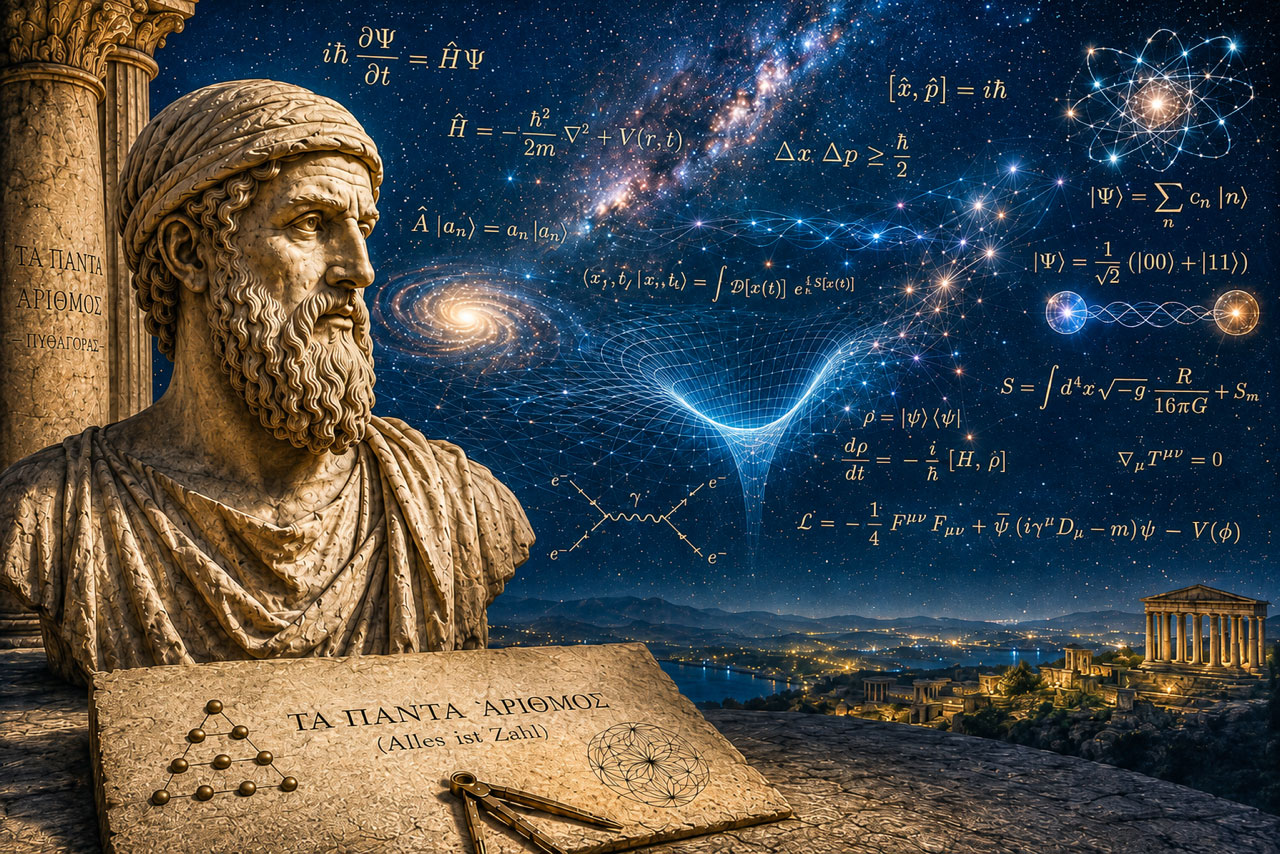
“All is number.” This famous saying is attributed to Pythagoras, one of the best-known pre-Socratics. Almost no direct writings survive from these early Greek philosophers. What we know about their teachings comes mostly from later sources, such as Plato and Aristotle. Even so, it’s clear how groundbreaking their thinking was, not just for the development of philosophy, but for the sciences as a whole. With the pre-Socratics, a new way of understanding the world begins. Natural phenomena were no longer to be explained solely by the arbitrary actions of gods, but by recognizable, objective, and testable laws. This marked an intellectual turning point: the world became something that could be observed, studied, and understood through reason. Out of this stance, the various sciences gradually developed.
But Pythagoras added a second, perhaps even deeper insight. He sensed that nature doesn’t just follow general, objective laws, but that these laws express themselves in a special way through numbers. Numbers became, for him, the key to understanding the world. What may have looked at the time like a bold philosophical intuition has been confirmed, in impressive fashion, in the centuries since: anyone who wants to describe the processes of nature precisely runs, again and again, into the phenomenon of number.
As science developed, it became ever clearer that no other tool can describe natural processes as precisely as mathematics. Whether in the equations of physics, the formulas of chemistry, the models of biology, medicine, or even psychology: we encounter numbers, ratios, structures, and mathematical order everywhere. Without mathematics and geometry, the modern natural sciences would be almost unthinkable.
„Mathematics is the language with which God has written the universe.“
(Galileo Galilei)
But the significance of numbers isn’t limited to the natural sciences. They’ve always played a fundamental role in culture, language, and writing as well. This shows up especially clearly in the origins of our alphabet. Many early writing systems linked letters not just to sounds, but also to numeric values at the same time. In the Hebrew alphabet, for instance, every letter is also assigned a number. That’s why we speak of letter-numbers, or gematria. Our own Latin alphabet, too, sits in a line of development that traces back through the Greek to the Phoenician alphabet, one of the decisive roots of alphabetic writing culture. This shows that numbers were never just a tool for calculation, but, from the very beginning, also a basic element of human order, language, and meaning.
„The natural numbers were there before there were human beings, or indeed any other creatures here on Earth, and they will remain after all life has perished.“
(Roger Penrose, contemporary mathematician, physicist, and Nobel laureate)
In the information age, this special standing of numbers finds a new, almost overwhelming confirmation. Nearly all digital information today is stored in bits: a code made of two distinguishable states, which we represent as 0 and 1. From the arrangement of these two symbols come texts, images, music, films, programs, and, ultimately, the very systems of artificial intelligence that increasingly shape our present. With just two numbers, humanity’s entire accumulated knowledge can be encoded, stored, and passed on.
Pythagoras, of course, couldn’t have foreseen any of this. But in number, he recognized a basic element that is timeless and universal, because it’s anchored deep in the structure of nature. That’s precisely why we keep running into it, in the natural sciences, in culture, in digital information, and, finally, in artificial intelligence as well.
What Remains Is the Number
Mathematics and numbers have contributed, in a truly unique way, to exploring and describing the world and the laws underlying it. However revolutionary some discoveries were, and however much they shook up earlier scientific ideas, numbers and mathematics stayed constant. When Einstein showed that Newton’s physics doesn’t hold everywhere, and that space and time aren’t fixed quantities, an entire worldview was shaken. But the newly discovered laws could still be expressed mathematically. Even when quantum physics, with its findings that at first seemed absurd, called the classical notion of reality into question, the language of numbers held firm. Theories change, but the basic element we use to describe natural phenomena seems remarkably stable.
Today’s physics has moved far, in time and in substance, from the teachings of Pythagoras. The sciences have advanced enormously, becoming more complex, more precise, and more specialized. But no matter how deeply they now probe into the vastness of the universe or the smallest scales of the quantum world, and however controversial some current debates may be, most scientists would probably still sign off on the pre-Socratic’s core idea: “All is number.”
In Search of a Theory of Everything
But that’s not the end of the story of numbers. Right where modern physics runs up against its limits today, surprising new parallels to Pythagoras’s 2,500-year-old teaching emerge. To understand what these parallels are, it’s worth first taking a look at the big open questions in physics today.
Modern physics rests on two powerful pillars: Einstein’s general theory of relativity and quantum mechanics. One describes the large scale: gravity, space, time, stars, black holes, and the universe as a whole. The other describes the small scale: atoms, elementary particles, light, and the strange probability laws of the microscopic world. Both theories rank among the most successful intellectual achievements in the history of science. But precisely where we’d need them together, they clash: at the Big Bang, inside black holes, and when asking about the deepest structure of reality.
Relativity understands gravity as the curvature of space and time. Quantum mechanics, on the other hand, doesn’t describe the world as a fixed, clearly defined stage, but as a web of probabilities, states, and relationships. A theory that brings both perspectives together is called quantum gravity. To this day, it remains one of the great unsolved problems in physics. Modern research is therefore searching for a deeper order behind space, time, matter, and energy: a structure from which both the world of the largest and the world of the smallest emerge. In this context, people often speak of a “Theory of Everything,” or, in everyday language, a “world formula”: a single, foundational, unifying principle.
A Grainy World Without Solid Things
Physics has faced this problem for about 100 years now. Among the best-known lines of research are string theory, loop quantum gravity, and approaches based on holography and quantum geometry. But a generally accepted theory that unites both major pillars of physics has not yet been found. Still, two basic ideas seem to be crystallizing out of the wide range of current research approaches:
- Nature evidently has a grainy structure. Many of its phenomena can’t be divided up indefinitely; instead, they point to smallest units, quanta, or building blocks. Even light, in this view, appears not only as a wave, but also in discrete packets of energy.
- On closer inspection, though, these building blocks aren’t solid, hard things in the classical sense. They appear, instead, as events, states, or interactions that are only defined through their relationships to one another. In the quantum world, then, we encounter less a world of stable objects than a swarm of intangible states.
So scientists are looking for something that makes sense of both properties at once: a world of smallest units that still doesn’t consist of solid things in the classical sense.
Information: Where Order Gains Meaning
In the process, modern research increasingly runs into the concept of “information”:
“Even this brief overview makes it clear that the concept of information plays an enormous role in today’s attempts to understand the world. From the structure of communication systems to the genetic basis of biology, from thermodynamics through quantum mechanics to quantum gravity, it clearly seems to be advancing more and more as a tool for understanding the world.”
(Carlo Rovelli, contemporary quantum physicist)
What does information mean in this context? A particle, then, wouldn’t simply be a small material grain, but more of a unit of information. Something that can’t be defined in isolation on its own, but only through its relationships to other things. It exists through interaction and ordered relationship within a larger system. In short: information is arrangement.
In everyday language, we usually understand information as something else: a piece of content, whether a message, a thought, or an idea, that travels from a sender to a receiver. At first glance, this content seems almost immaterial. It’s something that isn’t matter itself, but carries meaning.
At first glance, the two concepts of information seem to differ: the physical one speaks of a formal arrangement, the everyday one of a message with content. In fact, though, they point in the same direction. This becomes clear when we picture the smallest unit of digital information: the bit. A bit can take on two distinguishable states, usually represented as 0 and 1. Content arises from the arrangement of such states. The same two symbols, 0 and 1, can, depending on their order, produce texts, images, music, or entire programs. The bit makes it especially easy to see that information arises from distinction, order, and arrangement.
So what matters isn’t the building blocks alone, but their place within the system. It’s only their order that gives rise to information in the sense of content. Information is therefore a matter of structure. The word itself points to this: “information” comes from the Latin informare, which means roughly “to give shape” or “to bring into form.” Information arises where something isn’t merely present, but takes on a particular shape, order, or structure.
Information, then, is meaning that arises out of order.
At the Root of Order Stands the Number
At this point, the concept of information leads natural scientists to the phenomena of order and arrangement. That’s remarkable, because in their search for new connections in the depths of the quantum world, they suddenly run again into an element that has counted among the basic tools of their daily work ever since Pythagoras: numbers. It’s the cat chasing its own tail. Because numbers are the simplest expression of arrangement. Nothing creates order in a more original form: 2 follows 1. Every child understands that. Numbers are the epitome of order, its archetype.
But if information arises out of order, an unusual question arises: what information, then, does order itself carry? What meaning lies within numbers? With that, we step onto terrain that seems, at first, foreign to modern thinking. Because we’re used to treating numbers as pure formal elements: neutral tools for calculating and measuring. But if information is meaning that arises from order, then the question can’t be avoided: are numbers, too, more than mere quantities?
Let’s look at this through the lens this train of thought has just given us: if information arises from order, and numbers are the most original expression of order, an unusual question arises. What information, then, does a number carry within itself? What meaning lies in the 1, or in the 2?
At first glance, the answer seems clear: none. We treat numbers as pure quantities, as neutral symbols for counting and calculating. But on closer inspection, it’s not that simple. The 1 already carries within it the information that it is the first number. It stands at the start of the sequence. It’s also, at the same time, contained in every natural number that follows. The 2, in turn, carries the information that it follows the 1. It’s the second, the other, the first number after the 1, and yet it too contains the 1 within it. These are no longer merely computational observations. They’re statements of content, about position, relationship, and meaning within an order. This shows that numbers aren’t just quantitative elements. A quality already emerges from their quantity.
Pythagoras’s Forgotten Half
At this point, it’s worth looking back at Pythagoras. As we’ve seen, his claim, “All is number,” was remarkably accurate, though he obviously had no way of knowing that quantum physics, the periodic table, or today’s world of bits and bytes would, millennia later, use this exact language to describe, order, and store reality.
But that’s only one half of his teaching. It held more than the famous foresight that the world could be calculated remarkably well using the element of number. For Pythagoras, numbers were more. Another saying is also said to come from him:
„Number governs forms and ideas.“
(Pythagoras)
In other words: he saw numbers not just as a quantitative, calculating element, but also as a qualitative one, one with content. For him, they were also carriers of ideas. That’s certainly not unknown to scientists today. But the content-based side of his teaching is usually deliberately set aside. For modern science, it belongs more in the realm of numerology, so, close to esotericism, or, put more bluntly, in the realm of fairy tales about seven dwarfs behind seven mountains. In any case, not in the realm of science:
“Plato freed Pythagorean thought from its unwieldy and useless mystical baggage, and filtered out the useful message: the right language for understanding and describing the world is mathematics. This intuition was of enormous consequence, and became one of the foundations for the success of Western science.”
(Carlo Rovelli)
But aren’t we throwing the baby out with the bathwater here? Is it really convincing to celebrate Pythagoras, on the one hand, as a pioneering thinker of scientific world-explanation, while, on the other hand, discarding the second half of his number theory as mystical baggage? Maybe this also reveals a certain arrogance in modern thinking: just because the ancient thinkers couldn’t yet fly to the moon, we don’t credit them with the possibility that they might have recognized something that, over time, got buried.
Can the modern separation of quantity and quality still be maintained in light of the newest phenomena in quantum physics? On closer inspection, Pythagoras, by linking form and idea, was simply expressing that there’s no form without content. Hardly any modern scientist would seriously dispute that claim. Content and form depend on each other. Every form is the expression of some content. A symmetrical blossom points to a blueprint behind it. Content shows up through form. Form conveys content.
And modern physics runs into something similar. Properties emerge through the act of forming: through arrangement and relationship. This shows up especially clearly at the atomic level: the elements of the periodic table don’t differ because they’re made of completely different basic substances, but through the number and arrangement of their particles. Hydrogen, oxygen, or iron are ultimately made of the very same basic building blocks. Their different properties, their qualities, arise solely through their number and arrangement. Quantity and quality depend on each other.
What Numbers Might Be Telling Us
So if quantum physics leads us to the concept of information, if information arises out of arrangement, and if the most original element of order is number, then the decisive question arises: what information, what quality, does number itself carry?
So maybe we should step down once more from the throne of modern natural science and ask its founding father what he actually meant by the other half of his number theory. Maybe he could help us describe a shared ordering principle underlying these opposing theories. Maybe he still has something interesting to tell us.
Related Topics:
More on The Philosophy of Numbers.
FAQ
What connects Pythagoras and quantum physics?
Both, in their own different ways, grapple with the question of whether numbers and mathematical structures describe fundamental properties of reality. This article explores why modern physical theories show surprising parallels to ancient number theory.
What does the phrase “All is number” mean?
This saying, attributed to Pythagoras, describes the idea that the order of the world can be understood through numbers and mathematical relationships. Many scientific discoveries of the modern era seem to confirm this idea.
What role does information play in modern physics?
In many current approaches to quantum physics and quantum gravity, information is treated as a fundamental building block of reality. Properties arise not just from matter, but from relationships, order, and structure.
Are there connections between Pythagoras and quantum physics?
Even though more than 2,500 years separate them, both ask what meaning numbers hold for the structure of reality. That’s exactly the idea at the heart of this article.
What is a Theory of Everything?
A Theory of Everything is the attempt to unite relativity and quantum mechanics into a single, fundamental theory. It’s meant to describe the deepest structures of the universe.

About the Author
Dr. Dr. Ruben Stelzner
A scientist, humanities scholar, entrepreneur, and philosophical author, Dr. Dr. Ruben Stelzner writes about universal principles, archetypal patterns, and the roots that science, religion, art, and culture share.
His book Verlorene Weisheit (German for "Lost Wisdom") is dedicated to the question of how timeless principle can again provide clarity and orientation today.
FOLLOW HIM
More at
rubenstelzner.com
TO THE BOOK
Verlorene Weisheit