The Philosophy of Mathematics: Where Numbers Meet Logic
Mathematics: The Language of Nature
The oldest mathematical records we have are 4,000 years old, from northern Egypt and what’s now Iraq. Remarkably, mathematics developed in parallel, and independently, across some of the most different regions and cultures on earth. We have sources from China, Europe, North Africa, the Middle East, Central and South America, and India. Everywhere, people got excited about it. There’s a reason that makes sense: nothing else seemed to describe what happens in nature as well as mathematics did. Mathematics seemed, and still seems today, to be the language of nature. Everything clearly follows its rules. People put that knowledge to use for countless calculations and their own construction projects. We know, for instance, that the ancient Egyptians must have had advanced mathematical knowledge to build the Egyptian pyramids (see also the article “What Makes Pyramids Special“). At the time, philosophy and mathematics were still inseparable.
In the Beginning Was the Number: A Bridge Between Philosophy and Mathematics
Today, we have one unified mathematics worldwide, and above all, one unified number system. The numbers we use today (1, 2, 3…) trace back to northern India. Numbers are the basic structural element of mathematics. Today, we can express and calculate almost anything with them, not just what happens in nature, but nearly the entire cosmos. Numbers are a kind of “programming language for the world.” Experts still consider it a genuine phenomenon that numbers carry this much weight in how our world actually works.
„To sum up what we’ve said so far: numbers carry real significance, altogether. They’re a key to the world.“
(Albrecht Beutelspacher)
People still argue about whether numbers are a genuine part of our world or something humans invented. In the end, though, that debate doesn’t seem to matter all that much, since scientists all agree that numbers are the best tool we have for describing nature.
That’s how numbers became not just the basic building block of mathematics and the geometry tied to it, but the alphabet of nearly every natural science. You’ll find them in the formulas of physics, the periodic table of chemistry, the calculations of biology, and plenty more.
Interesting Numbers
Today, numbers often come across as purely formal, content-free digits, useful for calculating and not much else. And yet, even the strictest natural scientists can’t deny that many of them come attached to impressive, even wondrous, sometimes downright mystical-seeming phenomena. That starts right with what we call certain number-related properties:
Take so-called “perfect” numbers, for instance: numbers that equal the sum of their divisors, like 6 (1 + 2 + 3 = 6). Then there are the highly composite numbers, numbers with an unusually large number of divisors, like 12, which has six of them (1, 2, 3, 4, 6, 12). Or the digital-root phenomenon, where the number 9 always behaves the same neutral way when you keep adding up a number’s digits (the digital root of 42 is 6; the digital root of 429 is 15, which reduces to 6). We can observe and calculate that certain numbers have these properties, but there doesn’t seem to be any reason why. Some phenomena feel a lot more mysterious, since certain number combinations clearly come with very special properties. So-called “magic squares” carry that idea right in the name. A magic square arranges numbers in a grid so that every row, column, and diagonal adds up to the same total. The simplest magic square has nine cells, and the sum is always 15.

Phenomenon: The Magic Square
The list of remarkable numbers with special, often unexplainable properties could go on forever: Why do prime numbers play such a universal role in mathematics, and yet can’t be calculated by any formula? Why is it pi, of all numbers, that describes the circle so distinctively?
Numbers and Messages
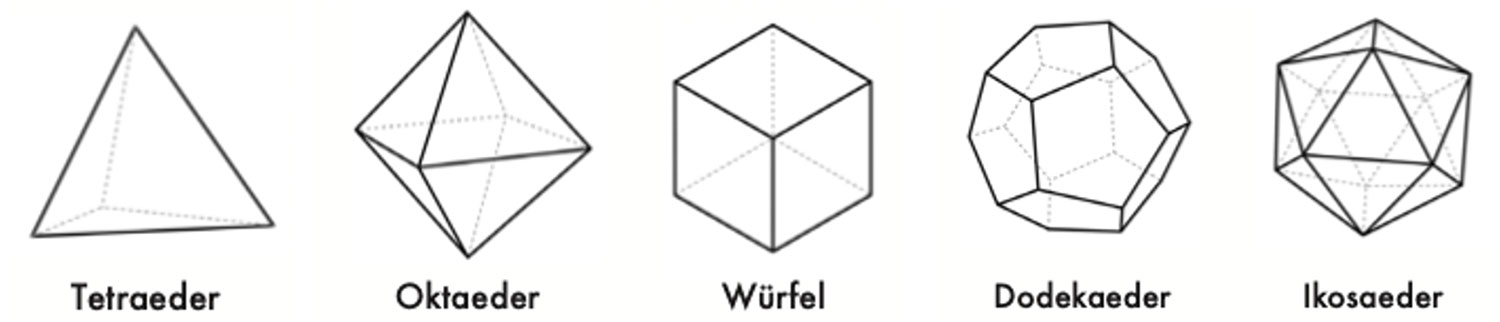
Geometry, a central part of mathematics, holds plenty more extraordinary properties tied to numbers, properties that shape the nature of our world in real ways. Take symmetry: we find it everywhere, and it’s closely tied to the principle of beauty. Another famous proportion is the golden ratio, often described as the “divine proportion” because it shows up so often in the forms of nature, and because it connects to how humans perceive beauty. Beyond that, the golden ratio and the Fibonacci sequence tied to it represent a growth pattern that shows up universally throughout life. (See also the article “Numbers in Nature” and www.golden-section.eu.) Also well known: the Pythagorean theorem, considered a sacred proportion by the early philosophers (see also the article “Numbers in Philosophy”), and the Platonic solids, which for Plato were the elements that made up the world.
„Probably not every number is interesting, but plenty of them have real character, and that’s especially true among the small numbers.“
(Albrecht Beutelspacher)
So numbers don’t just show up everywhere. They keep turning up connected to specific properties too. As much as strict natural science might like to separate the formal side of numbers from any meaning, that turns out to be difficult in practice. Numbers convey content, practically by nature. Philosophy and mathematics can’t be pulled apart. Numbers carry messages. That’s not just visible in names like “magic square” or “perfect number.” The bond between quantity and quality keeps showing up. Take the well-known “octet rule” in chemistry: atoms strive to have eight electrons in their outer shell, the way the especially stable noble gases do. The number 8 is directly tied to the property of stability. Drawing that connection between quantity and quality doesn’t fit today’s scientific standards, but the connection itself can’t be denied. It’s the same with physics concepts like the singularity (derived from 1), tied to the Big Bang, describing what the world arose from, in other words, what came first. Notice that 1 here isn’t just a content-free digit. Above all, it carries the message of “the first.” All of these phenomena show that the formal side of numbers can’t be separated from a qualitative one.
„…it seems reasonable to assume that there’s practically no basic number that hasn’t carried some special symbolic meaning in some culture, going back to the very beginning of counting and number systems.“
(Harald Haarmann)
The Limits of Mathematics
Strict mathematicians and hard-nosed natural scientists were long convinced that any symbolic side of numbers was unscientific and belonged to the realm of belief, while the purely formal side, by contrast, was objective and free of contradiction. Kurt Goedel disproved that conviction in the 1930s with his two incompleteness theorems. He discovered that every account of a mathematical system contains statements that can’t be proven. He also showed that no such system can ever prove its own consistency. That destroyed mathematicians’ hope of ever proving every mathematical statement conclusively. It was a revolutionary blow to the goal of making mathematics completely “safe and complete.” From then on, it was clear that formal mathematics could be proven no more fully than a qualitative view of numbers could.
„An equation for me has no meaning, unless it expresses a thought of God.“
(Srinivasa Ramanujan)
New Approaches
Partly because of these findings, more and more researchers are turning back to metamathematics. The goal: understand the foundations, structures, and rules of mathematics again from a higher vantage point. A more holistic view of numbers and mathematics as a phenomenon is coming back into fashion, even among natural scientists in the strictest sense. Thinking through the quantitative and qualitative sides together keeps becoming harder to avoid.
For the well-known physicist and Nobel laureate Roger Penrose, both the physical and the mental world are shadows of mathematical ideas. By his own account, that puts him in Plato’s camp: Plato defined ideas as primal forms that precede everything we perceive. Penrose is describing something more than calculation hiding within mathematics: primal ideas, in contrast to how we tend to understand math and numbers today. That makes clear just how tightly philosophy and mathematics remain intertwined, even now.
The philosopher Jacob Needleman calls for a fresh, open mind on the subject:
„I believe that life, every living thing, is a thought in time. If that’s true, there must be a kind of mathematics that expresses life. Just because the metaphysical language of numbers has already been misused by so many occultists and self-proclaimed Kabbalists doesn’t mean there’s no way to express the precise, measured laws of conscious reality.“
(Jacob Needleman)
What does Needleman mean by a “metaphysical” side to numbers? If numbers aren’t just digits, but carry meaning too, what could that meaning be, and where might it lead us? What would a philosophy of numbers actually look like? Find out more in the book Verlorene Weisheit.
Image Credits:
iStock.com/mustafahacalaki (Platonic solids), iStock.com/LagartoFilm (numbers on a green background)