“At least that’s how it is for me. I can’t let go of the numbers in the Bible anymore. They fascinate me, and I keep coming back to think about numbers and the secrets hidden in them.”
Prof. Dr. Jürgen Werlitz

Numbers in the Bible
The Meaning of Numbers in the Bible: More Than Just Numbers?
Wherever people write, you’ll find numbers. That sounds logical enough at first: numbers play a huge role in our lives. They’re an excellent tool for describing the world around us. We use them to state quantities, ages, sizes, dates, and plenty more. Numbers create order. They make the world tangible and calculable. So at first glance, it’s no surprise that numbers show up often in the best-selling book in the world, the Bible, just as they do in other texts. But is that really all there is to it? Are the numbers in the Bible just about order and chronology, or does how often they appear point to something deeper?
How Number Patterns Stand Out in the Bible
The first thing you notice: certain number combinations keep coming back in the Bible. Seven is probably the most prominent: God creates the world in seven days, there are seven deadly sins, seven sacraments, seven trumpets in Revelation, and Jesus speaks seven last words on the cross. Forty shows up strikingly often too, in the forty days of rain during the flood, the forty years wandering the desert, and the forty days Jesus fasts in the wilderness. Looking at these passages and what they mean, numbers could, in fact, have played a purely formal, counting role here, the same way we use numbers almost exclusively today.
Unrealistic Numbers as a Clue to the Symbolism Behind Them
But dig a little deeper and look at other numbers in the Bible, and something else quickly becomes clear: they can’t have served purely as facts or quantitative counting elements, because their values are very often obviously unrealistic. In other words, the quantities and sizes just can’t be right. Adam fathers his first son at 130 and then lives another 800 years. Noah becomes a father at 500, lives to 950, and Methuselah reaches 969. Numbers like these can’t be explained biologically, not even accounting for ancient living conditions or older counting methods. Other number combinations don’t make literal “sense” either, like the 666 in Revelation or the Ten Commandments. Why does the trek through the desert from Egypt to Canaan take forty years, when the distance as the crow flies is only about 400 kilometers? On a surface reading, you might consider these numbers pure coincidence, or arbitrary choices by the Bible’s authors who simply didn’t give it much thought. Maybe they wanted to grab attention with obvious inconsistencies? Or maybe they wanted to exaggerate, to make clear, say, that Adam was especially vigorous, or that the trek through the desert was especially grueling. But that kind of reading clearly falls short. After all, it’s hard to argue that the Bible consists of superficial, thin, or even arbitrary text. It’s not just the best-selling book in the world, and its content hasn’t just shaped faith for thousands of years. It remains, to this day, the foundation of countless societies and cultures. We have to assume its authors chose not just every single word deliberately and carefully, but also, maybe especially, the numbers that appear in it.
Number Symbolism in the Bible
But if the numbers aren’t meant to be understood quantitatively, at least not many of them, how should we understand them? Only one answer remains: the numbers in the Bible are, for the most part, symbolic in character. That means they’re meant to convey not just a quantity, or sometimes no quantity at all, but a message. That conclusion probably won’t surprise most readers; it seems obvious enough. But here’s the real question: if individual numbers were meant to express messages, qualities rather than quantities, what are those messages? What are the symbolic contents behind each number? What does 666 mean? Why did the people of Israel wander the desert for exactly forty years before reaching the promised land? Why does creation take seven days, and not eight or nine? Most readers will draw a blank here. And isn’t that remarkable? Everyone knows how central the Bible is to the world. Most people would also assume it’s an elaborate masterwork, where every element was chosen deliberately. Millions of people read it every day. It’s the central element of every Christian worship service. More than two billion believers assume it holds fundamental meaning for their lives. And at the same time, here’s the fact: in nearly every sentence, we stumble over numbers that carry more than quantitative meaning. Number symbolism is clearly playing an essential role. But we don’t understand what any given number is expressing. Theologians clearly find this topic puzzling too. Most are certain that numbers carry central meaning, that they convey essential messages, but they no longer know which ones. Some brush number symbolism aside, calling it an esoteric interpretation from past scholars that no longer holds up today, one that’s simply outdated. But that view comes across as arrogant, for a couple of reasons. First, we can hardly call ourselves more advanced or smarter if we no longer understand what people once did. And second, it’s not consistent to acknowledge the Bible’s fundamental importance and value for our societies and cultures on one hand, while dismissing or declaring meaningless one of its essential contents on the other.
The Bible: A Code Made of Numbers
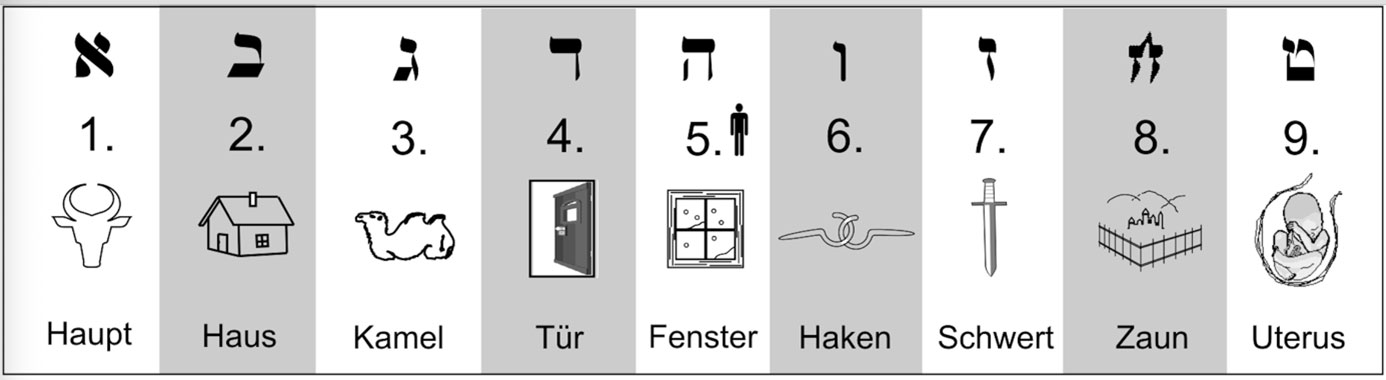
Another crucial aspect underscoring the meaningful role of numbers in the Bible is the language the Old Testament was written in. Ancient Hebrew doesn’t have a separate alphabet and number system the way German does. Instead, every Hebrew letter also carries a numerical value, similar to other ancient languages, like the Phoenician alphabet. That means every word is also a combination of numbers. The biblical text, in other words, doubles as a numerical code. And here’s what makes this genuinely fascinating: in Hebrew, not only is every letter tied to a number, but every number is tied to a pictorial symbol too. “Aleph” means the head (of a bull), “beth” means house, and “gimel” means something like camel. Here’s a quick overview of the first numbers, one through nine, and the symbols assigned to them:

Number Symbolism: Not Just in the Bible
It should be clear by now that numbers in the Bible carry symbolic meaning in many different ways. As interesting as that sounds, the Bible doesn’t play a unique role among sacred texts in this regard. Numbers carry central meaning in other spiritual traditions too. In the Chinese I Ching, in the Kabbalah tradition of Judaism, in the Vedic texts of India, you’ll find numbers everywhere that don’t just count, they tell. But we don’t need to look that deep into other cultures, or that far back in time. Number symbolism shows up in almost every fairy tale we read to our children (seven dwarfs, seven mountains, seven ravens, the devil with three golden hairs; see also: Numbers in Fairy Tales), in literary masterworks like Goethe’s Faust, and in landmark musical works like Mozart’s Magic Flute (see also: Numbers in Music). Even modern blockbusters use this kind of number symbolism: Master Yoda is 900 years old in Star Wars, Harry Potter lives at 4 Privet Drive, Trinity carries the number three right in her name in The Matrix, and films like Nine Gates and The Sixth Sense even carry the number in the title.
Numbers in the Bible: A Lost Body of Knowledge
What does all of this mean for how we approach the Bible? In an age when we mostly interpret the Bible literally, or analyze it as a historical text, a deeper understanding of its structure stays out of reach. Numbers in the Bible are rarely a purely counting element. They carry messages. If the numbers in the Bible carry a deeper, symbolic message, then it makes sense, or is even necessary, that we engage with them again. And not just to fully understand the actual content and build a richer theological and historical picture, but especially to better understand where our modern sciences and cultures actually came from.
„It is no accident that Scripture associates number with wisdom.“
Augustine (De Libero Arbitrio, Book II, referencing Ecclesiastes 7:25)
Curious to Learn More?
If you want to read the Bible not just as a religious text, but as a structural masterwork full of symbolic number codes, you’ll need to work your way back toward the deeper understanding earlier scholars once had. Knowledge of this number symbolism has faded away gradually over the centuries. Even though polymaths like da Vinci, Leibniz, and Goethe were clearly still familiar with it, we know next to nothing about it today. But that knowledge can be recovered. Find out more about the lost language of numbers and their archetypal meanings in Verlorene Weisheit.