Artificial Intelligence and Lost Wisdom
Why the Most Modern Technology [Holland1.1]Leads us Back to the Most Ancient Questions
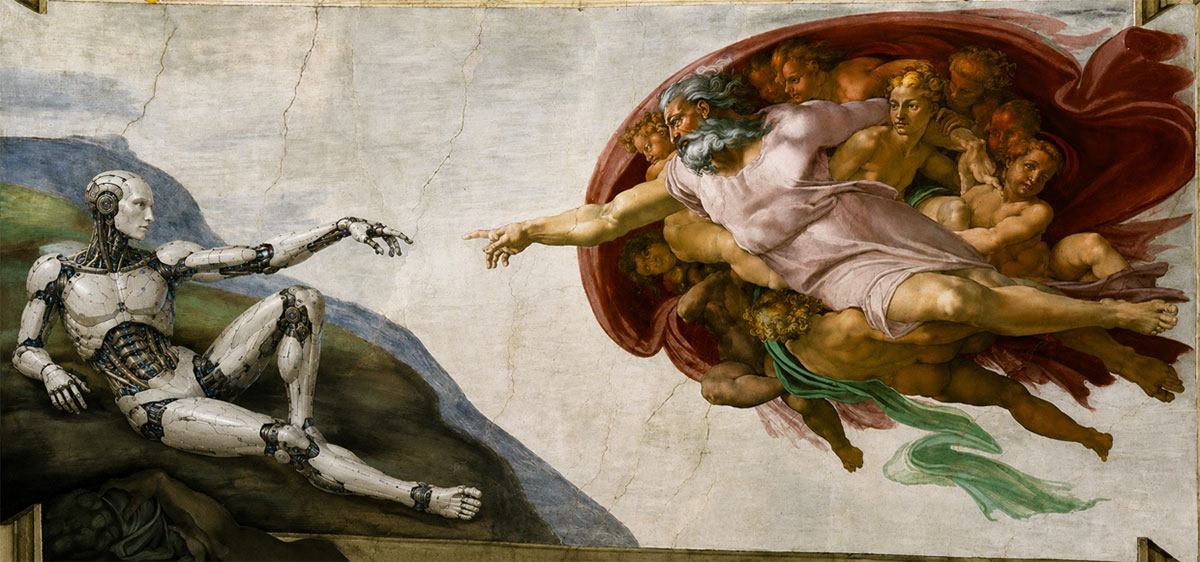
Artificial intelligence entrances and disturbs us, in equal measure. While promising undreamt of opportunities, it’s also entering into fields that we long thought were the exclusively human domains. The corresponding debates about what machines will be capable of in the future continue unabated. In so doing, they also lead us increasingly to a question that is older than any technology: what is the human, after all? As novel as artificial intelligence appears, the search for what it means to be human is one of the oldest going. And the more easily knowledge becomes available, the greater the longing for timeless wisdom.
New Technology, Old Fears
Artificial intelligence is the buzzword on everybody’s lips. It’s impossible to avoid it. Almost everyone agrees—it’s going to change the world, presumably as profoundly as the personal computer or smartphone have also done in recent decades. Tech corporations are pouring huge investment sums into its development. User numbers are growing exponentially. Companies and other organizations are commissioning reports from AI experts, sensing that their business and organizational models may soon be eroded to an even greater degree than hitherto. AI is new tech with a ginormous potential to change things. At least on this point, consensus prevails.
As grand as this might sound, the anxieties triggered by the phrase are comparably immense. But why? Because it’s something new, something that we don’t yet understand. Like a stranger, leading us into unknown territory. We sense that it’s going to change our world but do not know exactly how. We cannot calculate the future with any degree of certainty but fear that nothing will remain as it is now. That overchallenges us. Which rules should we hold fast to, when the familiar and the trusted no longer supports us? This is a fear of the unknown.
But is this particular unknown really as unknown as all that? The territory that we’re entering with artificial intelligence is, of course, new. Its landscapes are unfamiliar, as yet, its dangers something we can only guess at, and its possibilities can barely be comprehended. But this actual process is neither old nor particularly young. Humans have always moved into new territories—not merely geographically but also intellectually, technologically, and culturally. Each great innovation was just such a step out beyond the border of what was known. The territory that was entered was new in each case. But the pattern was familiar: Setting sail for uncharted shores has always been part of humanity’s history.
We recognize this pattern in history’s great innovations. Let’s go back to the early humans. Around a million years ago they learned how to make and utilize fire. What must it have felt like for them to suddenly have had such a powerful instrument in their hands? Previously, Homo sapiens had brought about changes primarily through its own muscle power. Now, with this new natural power, early humans felt the world was theirs for the taking. People were able to generate warmth, create light, and prepare a larger range of foods, meaning that much was now palatable that had formerly been inedible. Their diet became enormously more varied. But they were also now able to burn down whole landscapes, destroy forests, and set fire to the huts of other people. And all this happened: the wonderful and the destructive. Ultimately, however, the new force was tamed. We have not set fire to the earth, or not yet, at least. Instead, the mastery of fire heralded one of the great developmental steps in humanity’s history.
Such groundbreaking discoveries, which changed our world fundamentally, have sprung up time and again. The steam engine ushered in the Industrial Revolution. Out of electricity emerged infinitely more light, communication, computers, and ultimately the internet. Modern chemistry facilitated medicines, fertilizers, plastics, and many other new materials—but also poison gas, environmental toxins, and hazardous chemical cycles. Nuclear physics generated new energy sources and medical applications but also the atomic bomb and with it the possibility that humanity could obliterate itself entirely. All these innovations carried with them an enormous potential to change things but also filled people with dread. Because all of them contained a destructive potential alongside their undeniable utility. Nonetheless, we’ve now got them under control to such an extent that they are generally useful, for all their moral ambiguity. They are useful in enabling the majority to lead better lives than they would otherwise have done.
So this phenomenon of a new technology suddenly emerging, promising great changes while simultaneously triggering great uncertainty, is not new. Nor, it seems, are the anxieties set in motion when this kind of innovation shakes the worldview you’ve held to date. These anxieties also appear integral to such junctures. Whoever is unable to evaluate what’s coming toward them starts looking for orientation.
What Makes AI Different
AI could reasonably be integrated into this series: a further, powerful innovation that will effect huge change, and contains dangers, but which ultimately can be brought under control and put to use for humane purposes—hopefully for the good of humanity.
We could actually conclude our deliberations here. The pattern would be recognized, the danger classified. But in actual fact it’s not so easy. Why are the discussions about AI so heated? Why do they touch us at a far deeper level than many earlier tech debates? Why do we have the feeling that what lurks hidden behind this development is more than just a new tool? Does AI perhaps belong to another category of innovation after all, and one that does not simply follow familiar patterns? Does it possess different qualities?
The answer appears to be yes. And there’s a reason for this: AI is coming closer to us than earlier innovations. It touches something in us that we long thought was our exclusive preserve. Earlier revolutions, from fire to the steam engine to atomic energy, were technological innovations that harnessed the forces of nature more effectively. AI, by contrast, appears to go to work at quite a different level. It penetrates, it seems, into the very substance that makes us human. It crosses over onto human sovereign territory: language, knowledge, creativity, thought, and judgment. Territory that is out-of-bounds for machines—or so we thought.
Which prompts the next big question: Is AI our competitor? Will it become a danger for us, collectively and personally, and could it even replace us? Could its evolution perhaps even spell the end of ours?
The Machine’s Logic
To find answers to these questions, our path leads first to the question: What is AI in the first place? On first sight, it is software—trained on inestimable quantities of data. One comparison we can make is with someone who has read very many books. From these books, AI identifies probabilities and repeated patterns. When we present it with a question, it searches and processes its dataset, and produces an answer consisting of the words and word combinations that seem especially likely in that context.
When we ask it, “what’s a cow’s child called?” the AI searches for applicable patterns: which concepts appear frequently in its training data along with “cow” and “child”? That’s how it generally finds the right answer: a calf. But it doesn’t understand this answer, or this question, like a human would understand it. It doesn’t see a cow in front of it, doesn’t remember a stable, does not and cannot smell hay, and has no representative image of a calf standing in front of its mother. It merely calculates which answer is the most probable in the given context. If its training data would be different then its answer would also be different. If it had exclusively read texts containing statements that the child of a cow is a lamb, then it would probably answer “lamb.” Not because it would have confused a lamb with a calf, but rather because it has no idea, in its own visualization mechanism, or intuition, what both of these things are. For the AI, it doesn’t matter whether a lamb looks like a young cow or belongs to a cow. For it, the only thing that matters are the patterns that it has learned and is still learning from. Ultimately, an AI generates its answers from the dataset available to it, and the patterns it identifies in this set. Because the datasets used to train AI systems and platforms have already becomes huge, its knowledge appears to be unimaginably large. It can assemble astonishing combinations of words and “thoughts.” It has answers to almost all questions, and many of them are impressively correct. The amount of knowledge it can refer to exceeds that of an individual human by many times. It is impossible to possess anything close to the reservoir of knowledge that an AI has at hand—available to anyone today when they reach for their phone.
This naturally makes us feel scared. Because AI appears to know more than we do. And knowledge is a characteristic that we attribute to humans. The ability of deducing patterns from varied data is also part of what we understand when we talk about intelligence. As such, AI really does seem to be “superhuman,” threatening us in our core competences.
AI’s type of knowledge, which is huge and feels understandably threatening, nonetheless obscures our view of its simple foundational principle. It only knows what’s in its “books.” It can only access that for which it was trained. Its results are based on probabilities and contexts from the data available. Working this way, AI can certainly present logical connections in serial form, and can even discover patterns that humans have overlooked. But it does this within the type of logic that is preset by the data, model, and targets used. If it would be trained exclusively on German texts, it would have very good German skills but no English ones. If it had studied physics exclusively it would be excellent at explaining formulae but unable to say anything reliable about art. We could conclude: it is bound to the framework that AI’s operators, to date humans, have specified for it.
From a Dataset to Being Human?
Now the decisive question is: If we keep on expanding this framework, if we extend AI’s dataset to include all the knowledge and doctrines in the world, won’t it eventually stand on par with the human? Or even above her or him? Will it then be able to develop further by itself, like the human can? Could it thus be possible for it not merely to combine available knowledge but to make the decisive leap forward, from its own devices? To become able not merely to dread fire but to utilize it? To assert tenaciously, like Galileo and against the dominant worldview: “And yet it (the earth) does move.” To conceive of life, like Darwin, not as a rigid kind of creation but rather as development? Or to think, as Einstein did, of space and time no longer as fixed quantities?
Here we’ve arrived at the core of what we find threatening about this. To become more intimate with this core, it no longer suffices to ask what AI is. Instead, we have to ask: What is the human? Or, more precisely: What lies at the core of being human?
The Old Question About Being Human
The question isn’t new, and has not only presented itself now, with the rise of AI. It’s actually as old as humanity itself. Humans have always engaged with the question of what it means to be human. And they’ve always looked for answers to it. The older the questions, the older the answers that have been put forward. Of course, we could say: What do we care for the answers of older, technologically less developed cultures? What have they to do with our world today? We have changed. Our world is not the world people lived in hundreds or thousands of years ago. We have cars, smartphones, planes, and computers. While this is correct from today’s perspective, this only covers a small excerpt from the large matter at hand. Seen from a bird’s-eye view, we are astonishingly similar to the early humans. We have the same bodies and the same brains. We have the same: basic needs; anxieties about illness and death; longing to belong; need to solve problems; and wish to lead meaningful lives. What makes us happy or sad, fulfills us or leaves us in despair, is not completely different from earlier epochs. We have altered our environment but have remained the same sentient beings. That’s why the great questions remain the same: How can I lead a fulfilling life? How can I find my place on this earth? Which personal conduct do I see as right, and which as wrong? Humans of all eras and cultures have posed these questions—not superficially, nor in passing, but rather as central questions of their existence. To find answers, scholars, priests, philosophers, poets, and thinkers have searched, taught, argued, interpreted, and built impressive intellectual constructions. From these myths, religions, philosophical schools, rituals, and wisdom traditions have emerged. These were no childlike steps leading up to today’s knowledge but rather complete works in their own right, which described humans, their lives, and the typical challenges they faced in much detail.
Many of these traditions and heritages have become world famous today: the Buddhist doctrines, the Bible, the antique myths, Grimms’ Fairy and Folk Tales, but also modern narratives including The Lord of the Rings, Harry Potter, or Star Wars. However different these appear to be with regards to their contents, language, and cultural trappings, they nonetheless circle consistently around the same foundational questions about being humans: Where do we come from? Where are we going? What threatens us? What enables us to grow? How do we find our place in the world? These cultural artifacts tell stories about the human being, from his or her position in the cosmos, from their conflicts, anxieties, and temptations—and from the special possibilities that we all carry within us.
The Hero’s Journey as a Foundational Pattern for Being Human
As different as these stories might be, we know today that many of them are astonishingly similar in their basic structure. That’s not exactly surprising when we examine them more closely. If humans in all ages and cultures share a similar basic fate of being human then it stands to reason that their great narratives will follow similar patterns. The comparative mythologist Joseph Campbell had, by the mid-twentieth century, worked out the basic plot of many of these stories: the so-called hero’s journey.
Great stories generally begin in a familiar setting and social order. A human is born into a world in which everything runs its usual course. He (and often she) is a part of the whole, frequently of a village, a family, a kingdom, or of another comprehensible world. Everything is running along regular tracks. At first, it seems like just a single reality exists. It’s the Garden of Eden, in which Adam and Eve initially live in innocence. In many fairy stories it’s the kingdom in which the young princess grows up. It is the prosaic Muggles among whom Harry Potter is reared. It is the Shire in Tolkien’s Lord of the Rings, in which the story of the Hobbits begins. It is always, at first, a world one can trust, an easily graspable order with fixed rules, in which everything seems to have its place.
Yet this order never remains undisturbed for long. Suddenly something occurs that makes it clear to our still inexperienced protagonist and apprentice hero that the world they have known until now is not all there is to know of reality. The serpent disturbs the harmony of paradise. A psychologically dark queen or stepmother figure brings something evil into the kingdom. A threat rises out of the shadows: Mordor in Lord of the Rings or the Dark Side in Star Wars. In a flash, we start to see that an “outside” exists: something unknown, dark, and irrational, not bound by our everyday rules. The still inexperienced hero realizes that he doesn’t know everything, doesn’t have everything under control, and in that the world he’s lived in until now is incomplete. This signals the end of his unconscious life. He starts to sense what he’s missing. He perceives himself as an ignoramus and has a hunch that he must tackle the unknown head on. So he sets out. He leaves his trusted, familiar world, his old framework, his village, his own four walls, his “box.” The adventure commences. He crosses over into the land of the unknown, where other rules apply. Everything is irrational and incomprehensible. Nowhere ist light to be seen. And here he encounters that which is strange, hazardous, and unpredictable.
He gets to know new worlds on his journey, acquires new skills, and grows through enduring dangers and trials. He does not become a hero because he functioned particularly well in his old order but rather because he left that behind him, strode through the dark, and returned transformed. That’s why the treasure he brings with him is never a purely external prize. Rather, it’s a new experience, a new form of consciousness, and an extended understanding of himself and of the world that he returns to.
The Human is a Being Who Breaks the Frame
What do these stories tell us about being human? And what does this have to do with AI? All myths and wisdom traditions, religions, and cultures account for what belongs to the essence of being human through recognizing that there is always something that exists that goes beyond the individual human’s world. The human can thus experience that he is part of a larger world, a puzzle piece within a larger whole. And she or he will have the possibility to grapple with that which is other, strange, and as yet nor understood. On this path, doubt and dissatisfaction are more than just disturbances. Rather, they allow our protagonists, our heroes to leave their previous condition behind them, and to experience real change.
The matter at hand is not just fairy tales or fantasy stories. We’re also talking about the stories that life writes for us. As humans, we’re constantly leaving old worlds and pushing on into new ones, through: birth; starting school; leaving childhood; becoming adult; finishing our schooling; starting our professional lives; crises, illnesses, losses, new beginnings, and dramatic junctures. Recurringly, we depart from familiar structures, enter unknown spaces, learn new skills, and mature.
In contrast to animals, we can become conscious of this process. We can consciously realize that we’re missing something and then engage with this very thing. We get hungry and can ask: why? We get ill and can look for the causes. We want to make fire and can find out how this is possible. We want to fly and can research which laws of physics make flight possible. We can recognize and cognize who we are and, thus, what we’re lacking. We can look our ignorance in the eye and begin to engage with it. We can think about what we are lacking and about our own lack and failures, as a way to develop through them.
History’s Madmen
It is within this exact pattern that the great inventions and leaps in cognizance in humanity’s history resulted. Humans realized that they were lacking something and chose to engage with the unknown. To do this, they had to begin thinking and moving outside of their boxes, their villages, their previous mental structures. They had to advance into the unknown and question established rules. Galileo doubted the church-directed worldview of his day, by raising his eyes to the heavens, and taking seriously indications that did not fit into the order of that time. Einstein left the structures of classical physics behind him by no longer thinking of time and space as fixed quantities. Quantum physics blasted open habitual structures once again, by taking seriously phenomena that classical logic simply had no place for: indeterminacy, probability, and entanglement. Great insight and cognizance often emerge at those spots where humans have had the courage to transgress the rules of thought to date. At those places where the human is “mad” in the best sense of the word, because they are able to think beyond the habitual frame.
Perfect Imperfection
Humanity’s great strides forward set before our eyes what myths have been narrating for thousands of years: Only the human is able to experience their incompleteness and to use that to deduce that they are a part of a larger. Unlike other living creatures, they, the human being, is able to recognize their limits and to ask which larger structures surround them.
This gift of being in contact with that which goes beyond themselves, which only humans can possess, is to be found in the most varied world religions and wisdom traditions, also in the form of the divine spark, which is present in every human. “So God created mankind in his own image, in the image of God he created them.” (Genesis 1:27, New International Version) Michelangelo immortalized this image in unsurpassable form in the Sistine Chapel’s famous ceiling fresco. Adam, primeval biblical symbol of the human, almost gets touched by God. Tied physically tight to his own world, he will never be able to grasp perfection but has a connection to it nonetheless. It is this inner split, this dilemma, which only humans will ever be able to access. Artificial intelligence will never arrive at this kind of perfection.
But the more data and knowledge it serves up to us in the common knowledge, the more pressing the real question becomes: how do we return, from out of the storm of endless knowledge, to the peace of timeless wisdom?
Related Topics
More on Verlorene Weisheit.
For more on the topic of humanity and consciousness within the philosophy of numbers, see “The Meaning of Number 5: The Individual and Consciousness.“
FAQ
How can we differentiate artificial intelligence from being human?
Artificial intelligence processes data, recognizes patterns, and calculates probabilities. But being human goes far beyond that to encompass consciousness, personal experience, emotions, values, and the skill of giving your own life meaning.
Can AI replace humans?
Though it’s acknowledged that AI can take on many tasks and support humans in numerous fields, it is moot whether it can replace qualities such as self-reflection, the search for meaning, responsibility, or compassion. Such assertions remain controversial.
What is it about artificial intelligence that points us back to the question of being human?
The more powerful AI becomes, the more we ask ourselves what specifically makes humans unique. This paradigm-shifting tech development thus redirects our gaze toward one of humanity’s oldest questions.
Why does artificial intelligence spark anxiety in so many people?
New technologies have always prompted feelings of deep uncertainty. Added to that mix, in the case of AI, is the way it protrudes onto areas long regarded as particularly human, primarily language, creativity, and problem-solving.
Why are wisdom and responsibility becoming more important in the age of AI?
Artificial intelligence places knowledge at our disposal more rapidly and easily than ever before. Resultingly, being able to put knowledge into context, to take responsibility for it, and to reach wise decisions is becoming increasingly important.

About the Author
Dr. Dr. Ruben Stelzner
A scientist, humanities scholar, entrepreneur, and philosophical author, Dr. Dr. Ruben Stelzner writes about universal principles, archetypal patterns, and the roots that science, religion, art, and culture share.
His book Verlorene Weisheit (German for "Lost Wisdom") is dedicated to the question of how timeless principle can again provide clarity and orientation today.
FOLLOW HIM
More at
rubenstelzner.com
TO THE BOOK
Verlorene Weisheit