More Than a Custom: Why the Schaefflertanz Still Moves People Today
- A Tradition with a Special Aura
- The Plague Legend and Its Open Questions
- More Than Historical Folklore
- The Serpent as an Archetype of the Unknown
- The Journey into Darkness
- The Dance of Opposites
- The Arch as a Connecting Symbol
- The Mysterious Number Seven
- The Fate of the Black Nose
- From Misfortune to a New Perspective
- The Timeless Message of the Schaefflertanz
- FAQ on the Munich Schaefflertanz
- What Is the Significance of the Schaefflertanz?
A Tradition with a Special Aura
Hardly any Munich tradition embodies the city’s identity as powerfully as the Schaefflertanz. It’s far more than a historical guild tradition: for centuries, it has been part of Munich’s cultural self-image, and it shapes the city far beyond the moment of performance.
Its elevated status shows at one of Munich’s most visible and symbolically rich spots: the famous Glockenspiel on Marienplatz, which draws hundreds of visitors every day. The Schaefflertanz has always received a level of public recognition that hardly any other tradition can match. The first performance of a season, for instance, was traditionally reserved for the king, an honor that survives to this day in the custom of presenting the dance before the Bavarian State Premier.
For centuries, the Schaefflertanz has been, and still is, a cultural event of the highest rank, deeply rooted in Munich’s history and identity. It owes its special aura not only to its long tradition and the impressively elaborate performance, which the dancers rehearse for months, but also to its rarity: it’s performed only once every seven years. That rarity is exactly what has turned it, over the centuries, into a venerable and at the same time mysterious rarity that the city looks forward to again and again with great anticipation.
The Plague Legend and Its Open Questions
According to the well-known origin story, the Schaefflertanz dates back to the aftermath of a severe plague epidemic. The city is said to have been marked by illness, death, and fear; public life had come to a standstill. In these dark times, a single Schaeffler, a barrel maker, and later several of them, are said to have taken to the streets in 1517 to lure the frightened people back out of their houses. The dance was meant to give people courage to step outside again, to meet one another, and to find their way back into life.
As impressive as this story is, the historical attempts to explain it look thin in many places. Was there even a plague outbreak at the time of the supposed first performance in 1517? Historical death records don’t seem to support it. Why do the first records of the tradition only appear some two hundred years later? The attempt to explain the seven-year rhythm through a supposed recurrence of the plague every seven years looks just as scientifically questionable as the claim that a duke introduced the long pause to prevent traditional festivals from getting out of hand.
And what do fantastical figures like the serpent and the fool, or the timing of the performance during Carnival season, between Epiphany and Shrove Tuesday, actually have to do with the real history of a plague epidemic? A great deal points to the well-known origin stories resembling a legend or a symbolic tradition far more than an accurate account of facts.
More Than Historical Folklore
Given these open questions, is the tradition’s unbroken significance even still relevant today? Or should the Schaefflertanz, along with the long-past plague, have been filed away in the archives of history by now?
Hardly. It’s probably closer to the opposite.
Because the Schaefflertanz may not be telling the story of a single historical event at all, but of something more fundamental and timeless. Something whose pull, over the centuries, has if anything grown rather than faded. Its particular effect can hardly be explained by the beauty of a formally impressive performance alone.
Rather, the dance seems to be carried by something that was just as relevant then as it is now. Even centuries after the last plague, it still touches people in a strikingly immediate way. Something about it feels familiar, then and now. Maybe because, like many old rituals, myths, and traditions, it’s less interested in telling historical facts than in telling timeless truths.
The Serpent as an Archetype of the Unknown
If you set the purely historical-scientific view aside for a moment and turn your attention to the symbolic level of the tradition, surprisingly clear structures suddenly emerge.
After the entrance march, the Schaefflertanz always begins with the same figure: the dancers form a serpent. It’s meant to symbolize the lindworm that supposedly brought the deadly plague among the people. But the serpent is far more than just an image for a historical epidemic. It’s one of the oldest symbols in human culture.
Already in Genesis, the biblical story of creation, the serpent tempts Adam and Eve in the Garden of Eden, setting off the beginning of humanity’s path of suffering. The myth of Hercules also begins with two serpents that Hera, out of jealousy, places in the young hero’s crib. In the Nibelungenlied, Siegfried has to defeat a lindworm, and in Mozart’s The Magic Flute, Prince Tamino flees from an enormous serpent right at the start.
The Schaefflertanz draws on an archetype that has run through myths, fairy tales, and great stories for thousands of years.
But why does this image carry such a universal character?
The serpent symbolizes the being that comes from the unknown. The lindworm lives underground, the dragon in a cave. They’re creatures of the underworld, of darkness, of a shadow world. In Greek mythology, that’s Hades, the realm of the dead. It’s the world that stands opposite our world, the one we have no access to. It symbolizes the unknown, the thing we as humans can’t grasp, the thing tied to fate. It confronts us and represents a threat. It has an influence on our world. In the Middle Ages, the plague was exactly such an event. It broke over people without their being able to explain it. It was unpredictable, powerful, and seemed to come from beyond this world. People couldn’t understand it with the means available at the time, couldn’t calculate it, or even escape it. They were helplessly at the mercy of this event of fate.
Der Schäfflertanz bedient sich damit eines Urbildes, das sich seit Jahrtausenden durch Mythen, Märchen und große Erzählungen zieht.
Doch warum besitzt dieses Bild einen so universelle Charakter?
Die Schlange symbolisiert das Wesen aus dem Unbekannten. Der Lindwurm lebt unter der Erde, der Drache in einer Höhle. Es sind Wesen der Unterwelt, dem Dunklen, einer Schattenwelt. In der griechischen Mythologie ist es der Hades, die Welt der Toten. Es ist die Welt, die unserer Welt gegenüber steht, auf die wir keinen Zugriff haben. Sie symbolisiert das Unbekannte, für uns Menschen nicht Erfassbare und Schicksalhafte. Es begegnet uns und stellt eine Bedrohung dar. Es hat Einfluss auf unsere Welt. Im Mittelalter war die Pest ein solches Ereignis. Es brach über die Menschen herein, ohne dass diese es sich erklären konnten. Es war unberechenbar, mächtig und schien nicht von dieser Welt. Man konnte es weder mit den damaligen Mitteln verstehen, noch berechnen oder ihm gar entfliehen. Man war dem schicksalhaften Ereignis hilflos ausgeliefert.
The Journey into Darkness
The encounter with the unknown and the dark is one of the oldest motifs in human storytelling. In the Schaefflertanz, it’s the Black Death that people are at the mercy of.
In the fairy tale of Hansel and Gretel, the siblings leave their parents’ house, which stands in a clearing, a symbol of the familiar world, and lose their way in the dark forest, the counter-world of the unknown. There, they’re at the mercy of their fate. In The Frog King, the princess loses her golden ball in the dark well, and the frog, a symbol of a small dragon, rises up from the depths and confronts her with an unfamiliar reality she’ll have to deal with from then on.
The same basic motif shows up in modern stories too. In Tolkien’s The Lord of the Rings, Frodo has to leave his safe home, the Shire, and set out for Mordor, the “black land.” In the science fiction epic Star Wars, Luke Skywalker is confronted with the dark side of the Force.
All these stories ultimately circle around the same experience: human beings always live between two poles. No matter how orderly a life may look, sooner or later that order gets shaken by an event of fate. We encounter good and evil, light and darkness, health and sickness, life and death.
The Dance of Opposites
The Schaefflertanz tells the story, on many levels, of these two opposing poles that human beings are exposed to. Even the performers’ entrance happens in two rows. This doubling carries through into many of the later formations. The serpent mentioned earlier also develops out of two strands. At its core, it’s not one serpent, but two serpents that develop apart from each other.
This same interplay of opposites shows up in many other places, too. The dance impresses, above all, through the extraordinary structure and strictness of its sequence. Every step and every movement has to land exactly on the rhythm and follow an order laid out down to the last detail. At first, the clowns and fools who appear alongside the dance seem like they don’t belong. They differ from the dancers’ strict traditional uniforms not just through their colorful clothing. They also don’t submit to the dance in any way, but seem to act freely and on a whim. They sometimes brazenly break through the dancers’ rows, or try to distract them. This is how the performance vividly demonstrates the polarity between order and chaos, strictness and wit.
This same interplay of opposites also shows up, not least, in the Schaefflers’ step pattern. The entrance and exit march happen in lockstep. The figures, by contrast, are danced in a shuffle step. Here, the steps don’t simply follow each other in the same form: instead, every second step alternates which knee lifts. Through these different step patterns, the principles of sameness and variation are impressively set against each other.
The Arch as a Connecting Symbol
What is the Schaefflertanz trying to tell us with this?
With all its contrasting elements, it reminds us that we live in a world of polarities: order and chaos, light and darkness, life and death belong together inseparably.
The dance conveys the old wisdom that one pole never exists without the other. Even the plague doesn’t appear as a final state, but as part of a larger context that ultimately also has new life standing opposite it.
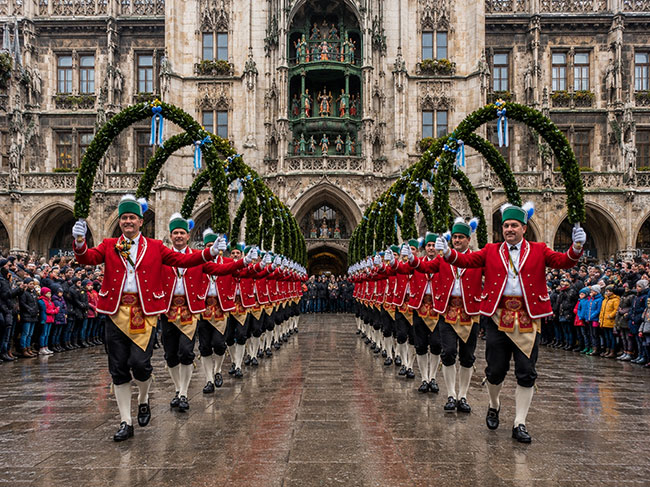
This becomes especially visible in the Schaefflers’ central symbol: the arch. In barrel-making, the arch binds the individual staves together and holds the whole thing in one piece. The same way it’s used in a bridge, the arch connects two opposite sides and brings together what at first looks separate.
Every Schaeffler carries an arch like this and is connected to the others through it. It’s usually made of boxwood, an evergreen plant that symbolizes permanence. Unlike foliage that fades, it stays green and lasting.
The arch makes it visible that opposites belong together: like two sides of the same coin. Just as day is unthinkable without night, light can’t be understood without darkness either.
That’s why the order of the formation always includes the fool’s apparent disorder, the very thing that breaks that order. The Schaefflertanz reminds us that even where darkness reigns, the light never fully disappears. Where sickness and death show up, life eventually returns too. The tradition carries within it the old wisdom that we can count on that.
The Mysterious Number Seven
The famous dance carries considerably more messages within it, beyond this. The mysterious presence of the number seven also fits into the bigger picture, seen through a symbolic lens.
According to tradition, the dance may only be performed once every seven years. It also consists of seven performance parts: the serpent, the arbor, the cross, the crown, four small circles, the changing formation, and the hoop swinging. In this sense, the number seven forms the framework of the entire ritual.
Outside the Schaefflertanz, too, we keep running into the number seven in myths, religions, and fairy tales. There, it often stands for wholeness and completion, though not through uniformity, but precisely through the integration of what’s foreign and different.
Snow White, for example, travels beyond the seven mountains to the seven dwarfs: into a foreign counter-world that ultimately helps her win her life back. In the Bible, God creates the world in seven days. At first, the seventh day seems like a counterpoint to the others, since nothing gets created on it. But that’s exactly what makes it holy: God rests.
In Judaism, the seventh day is the Sabbath, and the seventh year is the Sabbath year. Much like the rhythm of the Schaefflertanz, this reflects the idea that perfection only comes about once the seemingly purposeless, foreign, or different also gets its place.
The number seven also plays a special role in Hindu teaching. Human beings have seven main chakras, energy centers that influence body and mind. The seventh chakra, in particular, stands for the connection to the divine and the transcendent.
The Fate of the Black Nose
As human beings, we often don’t understand what role the unknown, the foreign, or fate plays in our lives. Such a connection often remains, for us, “a book with seven seals.” This saying goes back to the Revelation of John, also called the Apocalypse. There’s an important clue hidden right there: for someone who doesn’t recognize the deeper connection, the foreign at first appears dark, threatening, and destructive: an apocalyptic event. But anyone who understands the ordering meaning of the number seven recognizes in it not just downfall, but also revelation: the unknown unveils a hidden truth about the whole. That’s why the number seven stands, in many cultures, for both good luck and bad luck. What looks contradictory at first glance ultimately describes two sides of the same phenomenon: the workings of fate that enter our lives unforeseen. Whether we experience it as good luck or bad luck often depends on our point of view and how deeply we understand what’s happening.
This idea shows up especially vividly in a small, almost incidental detail of the Schaefflertanz: the clowns paint black color onto spectators’ noses, a mark that’s supposed to bring good luck. At first glance, that’s a striking contradiction. Because in the context of the plague story, black also stands for the Black Death, for sickness and threat. But it’s exactly through this gesture that the clowns connect both meanings together. They show that good luck and bad luck, light and dark, life and death, aren’t simply separate worlds, but different sides of the same coin. What matters is how a person meets the workings of fate: whether they experience it only as misfortune, or as part of a larger context that new insight, new confidence, and new life can grow out of.
From Misfortune to a New Perspective
The author Nassim Nicholas Taleb examined this principle in his bestseller The Black Swan. Black swans are extraordinary events with enormous consequences that seem to appear completely unpredictably.
The outbreak of the plague, the Black Death, was without a doubt exactly such an event for the people of that time, and not just because of the shared name. It arrived completely unpredictably, was incomprehensible, and had enormous consequences. Taleb writes that such events simply can’t be predicted. But he also stresses that they aren’t purely random: their cause lies in earthly, human conditions. The appearance of the plague pathogen itself was certainly random. But it only became a black swan, an event of enormous scale, because of the system that people themselves had built. They lived within an order of densely packed cities, poor hygiene, tight trade networks, and weak medical knowledge. Although the plague looked, at the time of its outbreak, like a random stroke of misfortune, we know today that it had to happen. It was a logical consequence of the living conditions of the time.
People who understood that fate isn’t just a completely arbitrary event were able to learn from the plague. They discovered the principle of quarantine, developed a better understanding of hygiene, and reorganized their cities. In retrospect, the horrors of the plague also led to developments that have saved countless lives ever since. As in many old stories, the path through darkness ultimately leads to new insight and new growth: think of Hansel and Gretel, who, after a painful journey, returned home from the dark forest with great treasures.
The Timeless Message of the Schaefflertanz
Of course, the Schaefflers couldn’t have known or predicted how this history would unfold. It’s part of the very nature of a black swan that this is exactly what’s impossible. But they knew, or at least those who perfected the ritual down to the last detail knew, about the principle of polarity. Because that principle is timeless. Countless stories tell us that shadow and light belong together. They knew that the workings of fate, however bleak they might look, are only one side of the coin. They knew that people, especially in times of great darkness, need that confidence again. And they knew that only a way of seeing that doesn’t separate opposites, but connects them, makes fate understandable and bearable.
It’s probably one of humanity’s hardest lessons that the workings of fate, and what’s foreign to us, belong to life. We don’t want that. We don’t understand it. We don’t need a serpent in paradise, no Hades in the world, and no plague in life. But every myth and every fairy tale tells us that good and evil exist, darkness and light, crisis and renewal, and then and now, the Schaefflers’ “sacred” dance reminds us that the hero’s art in a fairy tale, just like a person’s art in life, isn’t to be destroyed between the opposites, but to grow through them.
Munich can be proud to preserve, in the Schaefflertanz, a tradition of such beauty and depth, one that sends a hopeful message out into the world every seven years, a message just as important now as it was then.
FAQ on the Munich Schaefflertanz
What does the Schaefflertanz mean in Munich?
The Munich Schaefflertanz is considered a traditional custom with historical roots. Symbolically, it tells the story of how people deal with crisis, darkness, and renewal. Many of its figures and rituals point to timeless principles and ancient wisdom traditions.
Why does the Schaefflertanz happen every seven years?
Why the Schaefflertanz is performed every seven years isn’t clearly settled historically. Symbolically, though, the number seven carries special meaning in many cultures and often stands for wholeness, completion, and transformation.
What is the significance of the number 7 in the Schaefflertanz?
The number 7 shows up several times in the Schaefflertanz ritual. The dance consists of seven parts and is performed on a seven-year cycle. In religions, fairy tales, and myths, the number seven often symbolizes the connection of opposing principles.
Why do spectators get a black nose at the Schaefflertanz?
The Schaefflertanz’s black nose is traditionally considered a sign of good luck. At the same time, the black color points to the symbolism of the “Black Death,” connecting good luck and misfortune, darkness and renewal, as two sides of the same reality.
What does the serpent symbolize in the Schaefflertanz?
The serpent stands for the unknown and for fate. As in many myths and fairy tales, it symbolizes a person’s encounter with a dark counter-world, one that can trigger crisis, change, and ultimately growth.
What is the Schaefflertanz?
The Schaefflertanz is a traditional guild dance of Munich’s barrel makers, performed only once every seven years. It’s considered a symbol of life’s return after times of crisis, and it’s one of Bavaria’s best-known traditions.
What Is the Significance of the Schaefflertanz?
That’s exactly where the lasting fascination of the Munich Schaefflertanz lies. Its symbolism connects history, mythology, and human experience in a way that remains understandable to this day. Maybe that’s why the dance still touches so many people: because it doesn’t just tell us about the past, but about something that accompanies humanity timelessly.
- A Tradition with a Special Aura
- The Plague Legend and Its Open Questions
- More Than Historical Folklore
- The Serpent as an Archetype of the Unknown
- The Journey into Darkness
- The Dance of Opposites
- The Arch as a Connecting Symbol
- The Mysterious Number Seven
- The Fate of the Black Nose
- From Misfortune to a New Perspective
- The Timeless Message of the Schaefflertanz
- FAQ on the Munich Schaefflertanz
- What Is the Significance of the Schaefflertanz?

About the Author
Dr. Dr. Ruben Stelzner
A scientist, humanities scholar, entrepreneur, and philosophical author, Dr. Dr. Ruben Stelzner writes about universal principles, archetypal patterns, and the roots that science, religion, art, and culture share.
His book Verlorene Weisheit (German for "Lost Wisdom") is dedicated to the question of how timeless principle can again provide clarity and orientation today.
FOLLOW HIM
More at
rubenstelzner.com
TO THE BOOK
Verlorene Weisheit